

Why you’re here
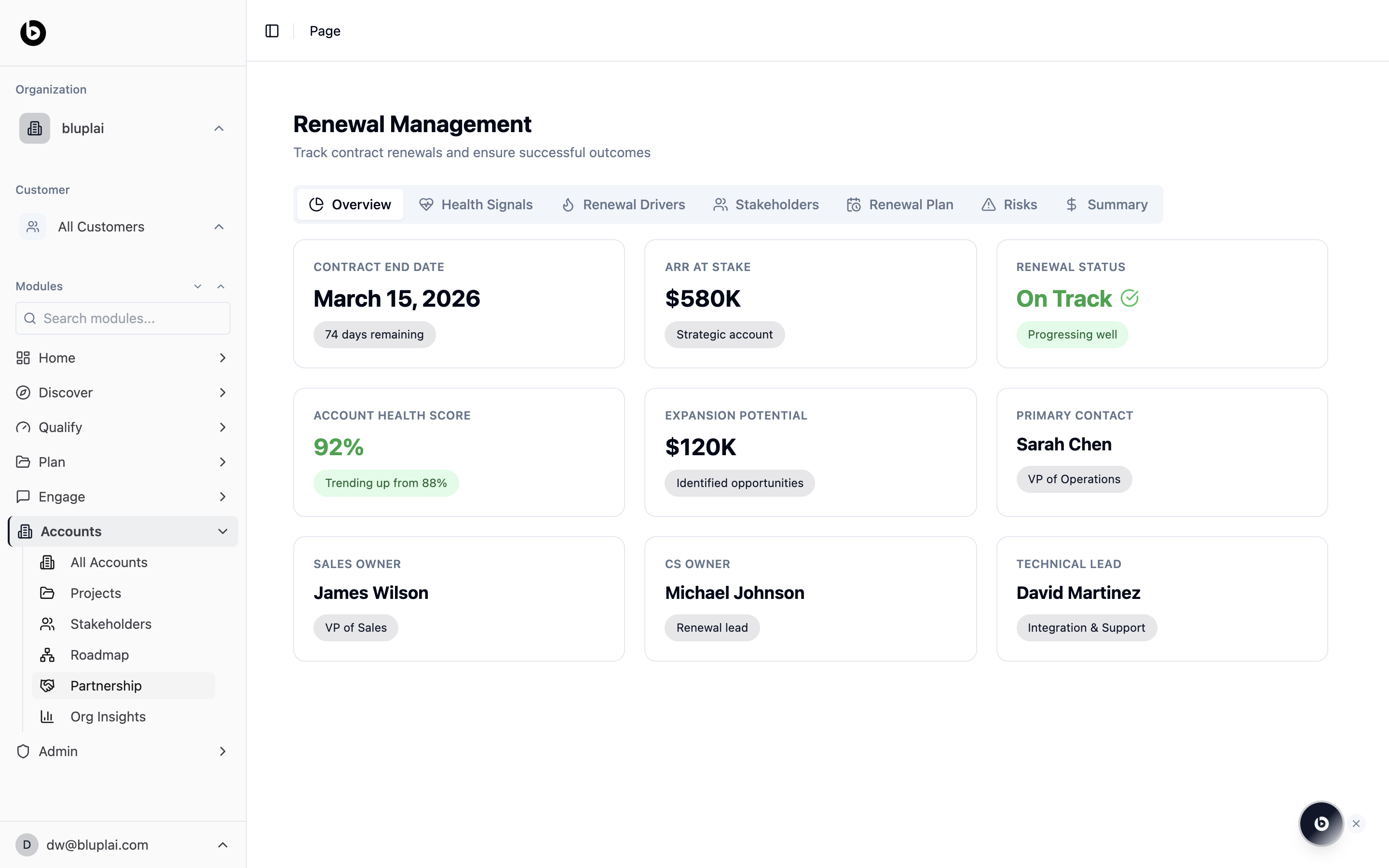
Partnership is where the relationship’s health, renewal drivers, and retention plan live. It’s the dedicated workspace for renewals and expansion — separate from the day-to-day Plan module because the motion is different: you’re not executing a project, you’re securing and growing the relationship. This is where you identify expansion or renewal opportunities based on engagement signals, then turn them into a plan.What you’ll see
A Renewal Management workspace with ARR, health, and owner summary tiles at the top and seven tabs:- Overview — at-a-glance summary of the renewal, with key dates, ARR, and status
- Health Signals — indicators of engagement, adoption, and overall sentiment from the customer
- Renewal Drivers — the factors that will influence retention and expansion (budget cycles, competitive pressure, executive sponsorship, etc.)
- Stakeholders — the people involved in the renewal decision, their influence, and where they stand
- Renewal Plan — the structured approach to secure the renewal and create room to grow
- Risks — threats to the renewal and the mitigation plan
- Summary — exec-ready recap of the renewal status
When to use it
- 90–120 days before renewal, when building the renewal plan
- Before a customer meeting where retention or expansion is on the table
- In internal pipeline reviews — renewal health is a first-class signal
- When you spot a health signal dropping and want to log a renewal risk
How it’s positioned
Unlike/plan/success-plan (which is about executing the current project), Partnership is about defending and growing the next commercial cycle. Both use stakeholders and health data from the same underlying workspace — Partnership just scopes them to the renewal lens.
Next
All accounts
The portfolio view — every account, every lifecycle stage.
Stakeholders
The people map that feeds the Stakeholders tab here.